Thursday, February 20, 2014

Amul Thapar is another US "bad apple" Judge


U.S. District Judge Amul Thapar.is another "bad apple" US  judge who clearly can not be fair minded and would make my list who cant see strait given the facts in my opinion, along with this nazi-American counterpart who you know must bee one of his buddies mention here as Jeff Theodore who sought, and I am quoting from these 2 news sources here in yellow and orange (2nd article)  .. as there is enough facts here to state my position and argue the case for true justice... as I'll show how true Nazi-American Justice had played out here ... though not all people in the US government officials are this kind of evil... 

Some government officials praised the activists for exposing the facility's weaknesses. But prosecutors declined to show leniency, instead pursing serious felony charges.

because of prosecutor ... Assistant U.S. Attorney Jeff Theodore said they had destroyed the "mystique" of the "Fort Knox of uranium."

These people have been in jail since the incident and according to the appeal process ...
In the meantime, the cases could be appealed, but that process could take 1.5 to two years, defense attorney Bill Quigley said.

FIRST OF ALL THESE PEOPLE MUST BE CLASSIFIED AS "PROTESTERS / ACTIVISTS" who clearly engage in actively going against such governments and there so-called laws to bring attention to the public... it' would be misdemeanor before any honest courthouse, and was originally filed as such...

NOW one can see clearly how the UNITED STATES GOVERNMENT abuses people rights by filing trumped up Felony charges as "Sabotage" was thrown into the mix by the nazi prosecutor in front of his buddy judge who don't even consider who the defendants are and give them no status as working for the public good and welfare in which they exposed how easy it would be to get into the "Fort Knox"of uranium and spend over 2 hours there... waiting to be caught.

The crime here is that they could not talk the legal mumbo jumbo or buy off this judge, as he must be on someone payroll, because he should not be on the people payroll (taxpayers money) if he can not judge fair. Let's face facts if the United States should consider itself blessed by God that these were "Christian" and not Terrorist who saw this unguarded opening into "Fort Knox" of Uranium, as they did the entire country a favor, because I'd bet  that given these same circumstances and a Terrorist HAMMERED ON THE SIDE OF THE HIGHLY ENRICHED URANIUM MATERIALS FACILITY, WHICH STORES MOST OF THE NATIONS BOMB-GRADE URANIUM ...

In Conclusion, to this case, I find fault and abuse of power by the US Government in railroading these innocent protester/activist  who cause the US government great embarrassment. This judge and Prosecutor should come under the full weight of law  ... to such mis justice ... They should be disbarred and find. (As the "fix was on" given statements from the ruling and sentencing)
The bad apple can not even sentence fairly, as 2 of them got 5 years and 1 got 3 years for the same so-called crime. 


... like the Greenpeace activists that were held in Russia... the government was smart enough to pardon such trumped up charge after people spoke out... I urge people to help get a "people pardon" for these 3 activist, as they did with GreenPeace 


Y-12 protesters: Nun sentenced to three years, men receive five  
POSTED AT  
BY  LEAVE A COMMENT

KNOXVILLE—The three protesters who broke into the Y-12 National Security Complex in July 2012 and splashed human blood and spray-painted slogans on a uranium storage building were sentenced to three to five years in prison on Tuesday.
Megan Rice, an 84-year old Catholic nun who last lived in Washington, D.C., received the shortest sentence. She was sentenced to 35 months, or just under three years. Rice is the oldest of the three anti-nuclear weapons activists. She also has the least extensive criminal history, Judge Amul R. Thapar said during a 4.5-hour sentencing hearing in U.S. District Court in Knoxville on Tuesday afternoon.
The other two protesters, Greg Boertje-Obed and Michael Walli, both were sentenced to 62 months, or a little more than five years. They have more extensive prior records. Boertje-Obed is a 58-year-old house painter from Duluth, Minn., and Walli is a 64-year-old Catholic worker and Vietnam veteran from Washington, D.C. Thapar said Boertje-Obed has 40 arrests and more than 20 convictions, and he has previously served time in prison. So has Walli. He was released on Jan. 5, 2012—about six months before the break-in—after an eight-month federal sentence for an earlier trespassing incident at Y-12
.“What do I do when eight months didn’t deter him?” Thapar asked defense attorney Chris Irwin. “It’s getting worse, not better.”
Thapar struggled to answer the question of how long the defendants should be locked up in order to deter them from repeating their offenses and to discourage others who might engage in similar actions. He was unsatisfied with answers to that question from either the defense or the prosecution. Defense lawyers recommended time served, while the United States recommended longer sentences. But Thapar said the recommended sentences seemed extreme given the circumstances and did not distinguish between saboteurs and peace protesters.
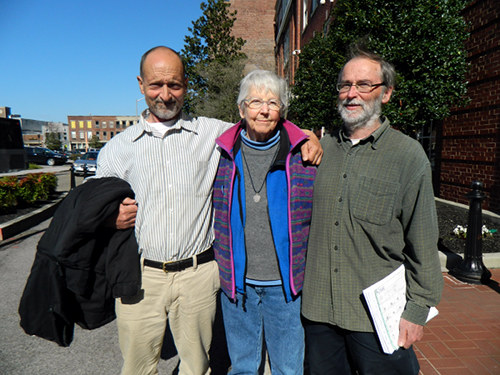
Y-12 Plowshares Protesters
Pictured above are the three anti-nuclear weapons protesters who broke into the Y-12 National Security Complex on July 28, 2012, and vandalized a uranium storage building. From left, they are Michael Walli, Megan Rice, and Greg Boertje-Obed.
“Here, it seems like overkill,” Thapar said of Rice’s recommended sentence. “Six-and-a-half years for Megan Rice? Isn’t it supposed to be sufficient but not greater than necessary?”
Announcing the shorter sentences, the judge cited Rice’s decades of service and Walli’s military history, among other things. And he said he gave similar sentences to Walli and Boertje-Obed to avoid sentencing disparities.
Even while emphasizing the importance of deterrence, though, Thapar acknowledged the good works of the defendants, which have ranged from volunteering in soup kitchens to teaching science in Africa.
“The court can say it is generally distressed to place good people behind bars,” Thapar said. “But, I continue to hold out hope that a significant sentence may deter…and lead (the defendants) back to the political process that they seem to have given up on. Without question, the law does not permit the breaking and entering into the secure facilities of the United States.”
Thapar urged the trio to use the political process and their community of supporters to go Washington, D.C., to try to abolish nuclear weapons.
“Breaking the law is not the answer,” Thapar said.
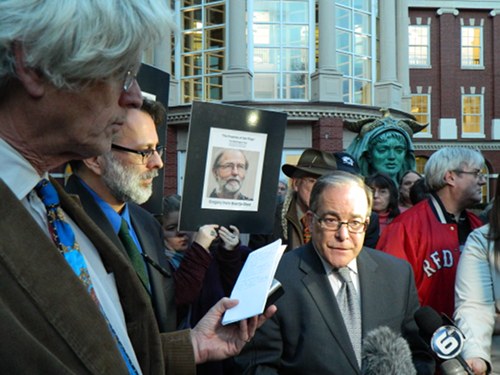
Francis Lloyd and Chris Irwin at Y-12 Sentencing Hearing
Irwin, second from left, is pictured with defense attorney Francis Lloyd at the Howard H. Baker Jr. U.S. Courthouse in Knoxville.
But it wasn’t clear that he had convinced the protesters. They and their supporters continued to insist that the nuclear weapons work being done at Y-12 violates international law.
“I make no apologies,” Walli told Thapar. “I am not remorseful. I would do it again.”
“We had to come to this facility, to call for its transformation,” Rice said.
All the sentences were less than the government had recommended, but federal prosecutors said they were satisfied.
“Judge Thapar had many complicating factors to consider, and we respect the sentences he pronounced today,” Assistant U.S. Attorney Jeffrey Theodore said Tuesday night.
Theodore said the defendants will receive credit for time served. They have been incarcerated since they were convicted in May 2013 on two felony counts of destroying U.S. property and attempting to injure national defense premises, a charge that falls under the sabotage section of the U.S. code.
Boertje-Obed, Rice, and Walli were each also sentenced to three years supervised release. And they have been ordered to pay roughly $53,000 in restitution for the damage caused when they cut through three fences in the high-security Protected Area at Y-12 on July 28, 2012, and splashed blood, spray-painted slogans, and hammered on the side of the $549 million Highly Enriched Uranium Materials Facility, which stores most of the nation’s bomb-grade uranium.
Defense attorney Chris Irwin had asked Thapar to release Walli on time served, which, so far, has been about nine months.
“My clients are going to prison for years,” Irwin said after the hearing when asked if he was pleased with the shorter-than-recommended sentences. “I’m never pleased to see people go to prison.”
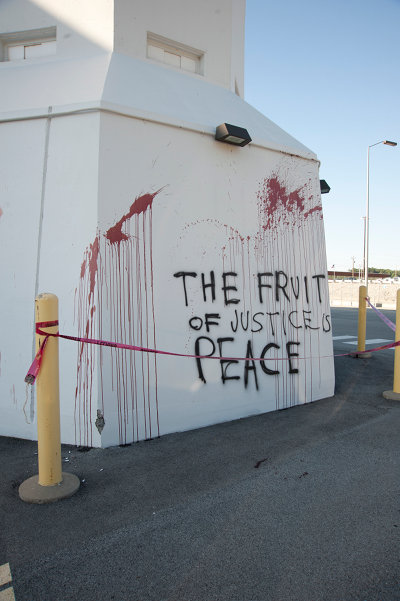
The Fruit of Justice is Peace Slogan on HEUMF at Y-12
Three anti-nuclear weapons activists cut through three fences in a high-security area at the Y-12 National Security Complex on July 28, 2012, splashed human blood and, quoting Proverbs, sprayed paint on the Highly Enriched Uranium Materials Facility. The protesters also hammered the building, causing it to chip, and strung up crime scene tape. (Submitted photo)
Walli had been facing the longest potential sentence, a range of about seven to nine years. Boertje-Obed’s recommended sentence had been about six to eight years, and Rice’s was roughly five to seven years.
Theodore called Boertje-Obed and Walli incorrigible habitual offenders whose criminal histories outweigh their good works.
“There has to be a heavy toll for people that are going to engage in this activity,” Theodore said. “They don’t have regrets about what they did. They are not going to be deterred.”
Rice asked Thapar for a life sentence, a request that was denied. She said her time in jail has been educational because she has learned about troubling prison conditions.
The three protesters, who called their Y-12 operation Transform Now Plowshares, have said they were nonviolent and religiously motivated when they broke into Y-12 in July 2012. They have said they were inspired by the nonviolent protests led by Martin Luther King Jr. and Mahatma Gandhi, among others.
But prosecutors argued during the May 2013 trial that the unprecedented security breach significantly disrupted Y-12 and interfered with the national defense. In addition to a two-week shutdown of nuclear operations and the damage to Y-12′s reputation, a secret shipment of materials that had been scheduled to arrive the day of the intrusion had to be delayed, prosecutors and government witnesses said during the May 2013 trial.
The 811-acre Y-12 plant was built during World War II to enrich uranium for the world’s first atomic bombs as part of the top-secret Manhattan Project. Today, it continues to play a key role in the nation’s nuclear weapons complex, storing most of the nation’s highly enriched uranium and supplying fuel for naval reactors, among other things.
Michele Naar-Obed, wife of Y-12 protester Greg Boertje-Obed, attended Tuesday’s hearing, and she said she has also participated in Plowshares protests. She said she thought a metaphorical window had been opened at the sentencing hearing.
“I am just feeling grateful that the judge was struggling with the letter of the law and the spirit of the law,” Naar-Obed said.
Boertje-Obed, Rice, and Walli are expected to serve at least 85 percent of their sentences. They could be let out early on supervised release if they receive maximum credit for good behavior.
In the meantime, the cases could be appealed, but that process could take 1.5 to two years, defense attorney Bill Quigley said.
“It’s going to be a long road,” Quigley said.
More information will be added as it becomes available.

_______________ 2nd article ----------
 Nun gets nearly 3 years in prison for nuke protest 
By TRAVIS LOLLER

KNOXVILLE, Tenn. (AP) — An 84-year-old nun was sentenced Tuesday to nearly three years in prison for breaking into a nuclear weapons complex and defacing a bunker holding bomb-grade uranium, a demonstration that exposed serious security flaws at the Tennessee plant.
Two other peace activists who broke into the facility with Megan Rice were sentenced to more than five years in prison, in part because they had much longer criminal histories of mostly non-violent civil disobedience.
Although officials said there was never any danger of the protesters reaching materials that could be detonated or made into a dirty bomb, the break-in raised questions about safekeeping at the Y-12 National Security Complex in Oak Ridge. The facility holds the nation's primary supply of bomb-grade uranium and was known as the "Fort Knox of uranium."
After the break-in, the complex had to be shut down, security forces were re-trained and contractors were replaced.
In her closing statement, Rice asked the judge to sentence her to life in prison, even though sentencing guidelines called for about six years.
"Please have no leniency with me," she said. "To remain in prison for the rest of my life would be the greatest gift you could give me."
She said the U.S. government was spending too much money on weapons and the military, and she told the judge about the many letters of support she had received, including one from youth in Afghanistan.
"This is the next generation and it is for these people that we're willing to give our lives," she said.
Rice, Greg Boertje-Obed (bohr-CHEE' OH'-bed) and Michael Walli all said God was using them to raise awareness about nuclear weapons and they viewed the success of their break-in as a miracle.
Their attorneys asked the judge to sentence them to time they had already served, about nine months, because of their record of good works throughout their lives.
Rice is a sister in the Society of the Holy Child Jesus. She became a nun when she was 18 and served for 40 years as a missionary in western Africa teaching science.
Walli's attorney said the activist served two tours in Vietnam before returning to the U.S. and dedicating his life to peace and helping the poor. Walli said he had no remorse about the break-in and would do it again.
"I was acting upon my God-given obligations as a follower of Jesus Christ," he told U.S. District Judge Amul Thapar.
The judge said he was concerned the demonstrators showed no remorse and he wanted their punishment to be a deterrent for other activists. He was also openly skeptical about whether the protesters caused any real harm and challenged prosecutors to prove it. Assistant U.S. Attorney Jeff Theodore said they had destroyed the "mystique" of the "Fort Knox of uranium."

They painted messages such as, "The fruit of justice is peace," and splashed baby bottles of human blood on the bunker wall.
On July 28, 2012, the three activists cut through three fences before reaching a $548 million storage bunker. They hung banners, strung crime-scene tape and hammered off a small chunk of the fortress-like Highly Enriched Uranium Materials Facility, or HEUMF, inside the most secure part of complex.
"The reason for the baby bottles was to represent that the blood of children is spilled by these weapons," Boertje-Obed, 58, a house painter from Duluth, Minn., said at trial.
Although the protesters set off alarms, they were able to spend more than two hours inside the restricted area before they were caught.
When security finally arrived, guards found the three activists singing and offering to break bread with them. The protesters reportedly also offered to share a Bible, candles and white roses with the guards.
The Department of Energy's inspector general wrote a scathing report on the security failures that allowed the activists to reach the bunker, and the security contractor was later fired.
Some government officials praised the activists for exposing the facility's weaknesses. But prosecutors declined to show leniency, instead pursing serious felony charges.
Prosecutors argued the intrusion was a serious security breach that continued to disrupt operations at the Y-12 complex even months later.
Attorneys for Rice and Walli, 65, both of Washington, D.C., said the protesters were engaged in a symbolic act meant to bring attention to America's stockpile of nuclear weapons, which they view as both immoral and illegal under international law.
Boertje-Obed's wife, Michele Naar-Obed, said before the hearing that she would figure out a way to deal with the sentence, whatever it was. Her real concern was that her husband's actions and imprisonment were not in vain.
"What I'm hopeful for is that people really could appreciate what he did and why he did it and who he did it for. He did it for all of us," Naar-Obed said.
The activists were found guilty on May 8 of sabotaging the plant and damaging federal property.
On Tuesday, about 75 supporters filled the courtroom and an overflow room where they watched the proceedings on a video feed. At a previous hearing, friends of the defendants testified to their good characters and kind hearts, saying the three had dedicated their lives to pursuing peace and serving the poor.
In addition to the prison sentences, each is required to spend an additional three years of supervised release and jointly pay nearly $53,000 in restitution.

Monday, February 10, 2014

Killing Americans with drones


Why not then target "Snowden"?  


WASHINGTON — The Obama administration is debating whether to authorize a lethal strike against an American citizen living in Pakistan who some believe is actively plotting terror attacks, according to current and former government officials.
It is the first time American officials have actively discussed killing an American citizen overseas since President Obama imposed new restrictions on drone operations last May.
The officials would not confirm the identity of the terror suspect, or provide any information about what evidence they have amassed about the suspect’s involvement in attacks against Americans. The debate about whether to put the individual on a kill list was first reported on Monday by The Associated Press.
The first time the Obama administration carried out a targeted killing operation against an American citizen was in September 2011, when a C.I.A. drone killed the radical preacher Anwar al-Awlaki in Yemen, officials said little publicly about the operation. The White House acknowledged last year that four American citizens had been killed in drone strikes during Mr. Obama’s time in office. According to the White House, only Mr. Awlaki had been intentionally targeted.
During a speech last May, Mr. Obama said he intended to gradually shift drone operations from the Central Intelligence Agency to the Pentagon, partly to make them more transparent. American officials said then that drone strikes in Pakistan would continue to be launched by the C.I.A. because Pakistan refuses to allow open American military operations on its soil.
However, under a classified policy issued by Mr. Obama there is a strong preference for the Pentagon — not the C.I.A. — to carry out drone strikes against American citizens, though the policy is said to allow exceptions if necessary.
American officials said that the new discussions about whether to strike the American in Pakistan had been going on since the middle of last year. The public got a glimpse of the debate last week when Representative Mike Rogers of Michigan, the Republican chairman of the House Intelligence Committee, spoke angrily about the drone restrictions imposed by Mr. Obama.
“Individuals who would have been previously removed from the battlefield by U.S. counterterrorism operations for attacking or plotting to attack against U.S. interests remain free because of self-imposed red tape,” Mr. Rogers said during a congressional hearing.
The new rules, Mr. Rogers said, are “endangering the lives of Americans at home and our military overseas in a way that is frustrating to our allies and frustrating to those of us who engage in the oversight of our classified activities.”
Still, several senior officials in both the executive branch and Congress confirmed that even though the policy establishes a baseline rule that only the Pentagon is to conduct drone strikes against American citizens, a clause makes an exception that would in theory allow the administration to use the C.I.A. to carry out a strike if circumstances justified it.
“This was Brennan’s brainchild,” said a senior congressional aide, who spoke on condition of anonymity because of the continuing policy debate over the matter, referring to John O. Brennan, the C.I.A. director. “They wanted to be able to talk about it, disclose it, and provide the legal footing for it.”
Details about the deliberations — including the identity of the proposed target, what he is accused of doing, and the quality of any evidence against him — remain murky. It is not clear how much reluctance by the administration to approve a strike is based on whether he meets the standard — a continuing, imminent threat against Americans — and how much other factors, like the complications raised by the military preference, are playing a role.
Despite Mr. Obama’s efforts to reform the rules governing the use of drones, they remain controversial. “So little has changed since last year, when it comes to government secrecy over killings,” said Naureen Shah, advocacy adviser at Amnesty International U.S.A. “The public and most members of Congress are still completely in the dark about where the U.S. claims authority to strike, the legal rules, and the identity of those already killed.”
“The policy is still the stuff of official secrecy and speculation, when it should be a matter of open debate and explicit constraints,” Ms. Shah said.
Spokesmen at the Pentagon, C.I.A. and White House declined on Monday to comment on the matter.
The administration’s ambivalence on this case has infuriated Mr. Rogers. “The chairman is fired up about this,” the congressional aide said.
The aide also confirmed that the Defense Department was initially reluctant to place the individual on the targeting list, questioning whether he met the new standards that Mr. Obama laid out last May. But eventually the Pentagon came around, said the aide, who added that the C.I.A. had supported a lethal strike from the beginning.

Saturday, February 8, 2014

Hmm... Russia - odds are ... Russia looks bad!

The odds are very likely that there well be a Terrorist act in the next couple days... 
Though this spying is far worse for Russia than any terrorist act, as it shows to what length people will spy ... 

As world watches Sochi, Russia watches the watchers

Reports suggest neither guests' laptops nor their bathrooms are safe from the eyes of Russian security.


As the world's eyes turn to Sochi for today's gala opening of the Olympic Winter Games, a good deal of evidence is piling up about about the massive scope of Russian security's take-no-chances efforts to keep tabs on every single visitor, pretty much all of the time.
Russian Deputy Prime Minister Dmitry Kozak, the official most responsible for overseeing Olympic preparations, didn't help matters much by seeming to tell journalists Thursday that Russian security has even planted surveillance cameras in their hotel bathrooms. 
According to The Wall Street Journal, Mr. Kozak was in the midst of a somewhat justified rant about the Western media's tendency to focus on (sometimes fake) minor shortcomings rather than pay some notice to the dazzling, ultra-modern facilities Russia has created for the Games, when he veered into speculation that some foreign guests might be committing deliberate sabotage to make things look bad.
Then he is quoted as saying: "We have surveillance video from the hotels that shows people turn on the shower, direct the nozzle at the wall and then leave the room for the whole day."
Oops.
The Journal adds that Kozak's aides quickly pulled him away, forestalling any further questions. A spokesman for Kozak later told journalists there were no such surveillance cameras in hotel bathrooms "for guests," but suggested they might have been used during the construction phase to keep an eye on workers.
Another example is a sharp piece of journalism by NBC foreign correspondent Richard Engel, who brought an IT expert with him to Sochi to find out how long it would take for his computers and cell phone to be hacked. The answer: "almost immediately."
Within seconds of switching on two brand-new computers, they were hijacked, Mr. Engel told NBC news. "In a minute, hackers were snooping around, trying to see how secure the machines were."
Then he received an official-looking email, purporting to contain important information for journalists covering the Games. When he opened it, a sophisticated Trojan took control of the laptop.
"The same thing happened with my cellphone. It was very fast and very professional.... The State Department warns that travelers should have no expectation of privacy. Even in their hotel rooms. And as we found out, you are especially exposed as soon as you try and communicate with anything," Engel said.
The scope of Russia's massive "ring of steel" security program aimed at keeping the Olympics safe from very real terrorist threats have been known for some time. Top security experts Andrei Soldatov and Irina Borogan of the online journal Agentura.ru have detailed a broad program of digital surveillance overseen by Russia's FSB security service that will collect all essential data on every participant, journalist, and guest attending the Games and leave no message, in or out, unread.
Mr. Soldatov argues that much of the data-harvesting has nothing to do with fighting terrorism and everything to do with spying on foreigners. He also points out that, despite its best efforts, the FSB's capabilities still do not match those of Western intelligence agencies such as the NSA and GCHQ, who've been exposed in great depth for indiscriminate mass spying by the revelations of Edward Snowden.
Following Soldatov's expose of the Sochi security plan, the official Voice of Russia radio station reassured its foreign listeners who might be thinking of visiting Sochi that there was nothing to worry about, because the surveillance is for everybody's own protection and, anyway, Russian secret services are not as "aggressive" as their US counterparts.
Indeed, it might be useful to ask whether Russia's security precautions for Sochi are particularly out of the ordinary for international events like this. This article from the Guardian almost two years ago described a security lockdown for the 2012 London Games that sounds every bit as pervasive and intrusive as what we're seeing in Sochi today.
"It's true that we saw most of the same things taking place in London," says Soldatov. "The main difference is that public opinion was engaged, and officials did respond to it. For instance, when there was a public outcry against using drones in London, the authorities backtracked and drones were not deployed.... Here in Russia we are not seeing any public debate about this at all. Public opinion just does not figure for our authorities, and that's a worrisome thing."

Friday, February 7, 2014

Stacked American Nazi secret Court - reveiled

To whom it may concern, Look more news of how they stacked the deck of so-called justice...


U.S. spy courts add two judges with Democratic ties


By David Ingram
WASHINGTON (Reuters) - Two secret courts that authorize U.S. spying operations such as the massive collection of telephone data are adding two judges who were put on the bench by Democratic presidents, a spokesman said on Friday, in a shift following criticism that one of the two courts is one-sided.
The appointments, to the 11-member U.S. Foreign Intelligence Surveillance Court and to the three-member U.S. Foreign Intelligence Surveillance Court of Review, came without comment from Chief Justice John Roberts, who in addition to heading the U.S. Supreme Court has exclusive power to determine the makeup of the two spy courts.
Roberts is a conservative judge appointed to the high court in 2005 by Republican President George W. Bush. The vast majority of the judges he has chosen for the spy courts have been Republican appointees.
Seattle-based U.S. Circuit Judge Richard Tallman joined the court of review for a term that started last month. Democratic President Bill Clinton appointed him as a federal appeals court judge in 2000. The court of review hears appeals from the lower spy court.
U.S. District Judge James Boasberg, based in Washington, D.C., will join the lower spy court in May. Democratic President Barack Obama appointed him as a federal trial judge in 2011.
Federal judges serve for life, but their terms on the spy courts are fixed at seven years. They go on hearing their regular cases while helping on the spy courts.
Civil liberties advocates, as well as Democratic Senator Richard Blumenthal of Connecticut, have said that the lower spy court risks its impartiality by having at one point 10 of its 11 seats held by Republican-nominated judges.
Congress created the two courts in 1978 after revelations that federal agents had routinely and unlawfully spied on Americans.
By law, the Foreign Intelligence Surveillance Court oversees investigations related to non-U.S. targets, and it usually approves requests made by Justice Department lawyers.
In an annual report to Congress that is publicly available, the Justice Department said that in 2012 the government made 212 applications for access to business records. The court denied none of the applications but amended 200 of them, the report said.
Leaks to the news media from former National Security Agency contractor Edward Snowden showed, beginning last year, how expansive the court's orders can be.
The court approved, for example, the creation of a database that includes information on virtually every U.S. telephone call, such as the length of the calls and the numbers dialed. Obama has ordered changes to that program.
(This story has been refiled to correct throughout to reflect Tallman's appointment to court of review)
(Editing by Howard Goller and Steve Orlofsky)
---------- some more info ----

The United States Foreign Intelligence Surveillance Court (FISC, also called theFISA Court) is a U.S. federal court established and authorized under the Foreign Intelligence Surveillance Act of 1978 (FISA) to oversee requests for surveillancewarrants against suspected foreign intelligence agents inside the United States by federal law enforcement agencies. Such requests are made most often by the National Security Agency (NSA) and the Federal Bureau of Investigation (FBI). Congress created FISA and its court as a result of the recommendations by the U.S. Senate'sChurch Committee.[1] Its powers have evolved and expanded to the point that it has been called "almost a parallel Supreme Court."[2]
Since 2009, the court has been located in the E. Barrett Prettyman United States Courthouse in Washington, D.C.[3][4] For roughly thirty years of its history, it was housed on the sixth floor of the Robert F. Kennedy Department of Justice Building.[3][4]
In 2013, a top-secret order issued by the court was leaked to the media by Edward Snowden. It required a subsidiary of Verizon to provide a daily, ongoing feed of all call detail records – including those for domestic calls – to the NSA.

FISA warrants[edit]

Each application for one of these surveillance warrants (called a FISA warrant) is made before an individual judge of the court. The court may allow third parties to submit briefs as amici curiae. When the U.S. Attorney General determines that an emergency exists he may authorize the emergency employment of electronic surveillance before obtaining the necessary authorization from the FISC, after which the Attorney General or his designee must notify a judge of the court not more than 72 hours after the Attorney General authorizes such surveillance, as required by 50 U.S.C. § 1805.
If an application is denied by one judge of the court, the federal government is not allowed to make the same application to a different judge of the court, but may appeal to the United States Foreign Intelligence Surveillance Court of Review. Such appeals are rare: the first appeal from the FISC to the Court of Review was made in 2002 (In re Sealed Case No. 02-001), 24 years after the founding of the court.
It is also rare for FISA warrant requests to be turned down by the court. During the 25 years from 1979 to 2004, 18,742 warrants were granted, while just four were rejected. Fewer than 200 requests had to be modified before being accepted, almost all of them in 2003 and 2004. The four rejected requests were all from 2003, and all four were partially granted after being submitted for reconsideration by the government. Of the requests that had to be modified, few if any were before the year 2000. During the next eight years, from 2004 to 2012, there were over 15,100 additional warrants granted, with an additional seven being rejected. In all, over the entire 33-year period, the FISA court has granted 33,942 warrants, with only 11 denials – a rejection rate of 0.03 percent of the total requests.[5]This does not include the number of warrants that were modified by the FISA court.
FISA warrant requests for electronic surveillance[a][6]
Year# Requests
Submitted
# Requests
Modified[b]
# Requests
Denied
Cumulative #
Warrants Issued
 1979–1999 12,082012,090
197919900207[7]
20001,0051013,102[c]
20019322014,036
20021,2282 [d]015,264
20031,724794 [e]16,988
20041,75894018,742
20052,07463020,814
20062,18177122,990
20072,37186425,360
20082,0822127,443
20091,32914128,763
20101,51114030,342
20111,67630032,087
20121,78940033,942
TOTALS33,94950411 [f]33,942
  1. Jump up^ Excludes physical searches


Saturday, January 25, 2014

Something that everyone should know

Everyone should be able to grasp what happens if these charges of "data the "government" collects for economic purposes means to the "global economy" 

If these charges are true the entire global market will go into a free fall. The dollar will become worthless because you don't have honest people in government. (As this falls into criminal activity and these people must stand trial and look at jail time. If the President Obama know,  this could be grounds for impeachment.

 This will not be good news for the Global economy. I predict Monday will be a real bad day for the economy (stock market) if there is any teeth to this story.


NSA also serves economic interests: Snowden interview


Berlin (AFP) - The US National Security Agency (NSA) sometimes uses data it collects for economic purposes, intelligence leaker Edward Snowden reveals in an extract of an interview with a German television chain to be broadcast Sunday.
"If there is information, for example on Siemens, which is in the national interest, but has nothing to do with national security, they will still use this information," said Snowden, according to the German translation of the interview on public television ARD.
The interview was carried out by a journalist for NDR, a regional chain belonging to the broadcaster that has analysed secret documents that Snowden leaked to journalists.
Under top secrecy, the chain this week in Moscow filmed the first interview with Snowden since he left Hong Kong in 2013 to seek refuge in Russia.
The 30-minute interview will be broadcast Sunday at 2200 GMT, with initial extracts to be released during an earlier talk show at 2045 GMT.
On its website, NDR said that Snowden assured he was no longer in possession of any confidential documents, as they had all been handed out to handpicked journalists. The former NSA contractor said he no longer wants to, or is able to, take part in any future revelations.
Other than the consequences of his revelations about NSA surveillance programs, Snowden will also address "his personal path" to leaking the information.
Snowden, 30, fled the United States in May last year after revealing that his government was collecting telephone data from millions of US citizens, monitoring vast amounts of private Internet traffic and eavesdropping on the conversations of foreign friends and foes alike.
On Thursday, in a question-and-answer session on the "Free Snowden" website, Snowden ruled out returning to the United States, where he said there was no chance of a free trial.
US Attorney General Eric Holder has said he was unlikely to consider clemency for Snowden.

Tuesday, January 21, 2014

Pre-World War 3 chatter... Plus a dream this morning..

Natural... ly

Postby Gus Who » Tue Jan 21, 2014 9:14 am
:lol: ... Hey... this one... NATURALLY... Ties too my  :2cents: 
:lol: ... This one... NATURALLY... you had to kind of listen too get the :2cents: ...

... I find myself in a room where I am listening too (mostly) a color commentary about events that are happening ... as I had the ability to speak back to the voice (male voice)... which sounded more like a live radio broadcast ... (at the events were happening)... 

Of coarse IRL ... Last night there was a lot of small background noises coming outside where I was sleeping... footsteps, talking ... that probably played into this ...


As this commentator who referenced people as "ghosts" on that side and their movements ... He would use terms in which the listener wold have make the connection to the kind of spirit that was floating in ... as the "Ghost" ... (As this dream seem to go on for a while..) though I can't remember most of the dialogue.. I do remember he like to use the term in gases as ... "Natural" ... Like in, look at that "natural gas" move... :yikes as it was about to blow (talking about world events natural.. :creeping: ly happening as events came too light :idea: 

Background: I do see this period coming up ( :infinity: as a seer) ... World War 3 / end time ...
Though also know that "Jesus" comes into this darkness to bring ... :idea:

This Nut-in-yahoo guy is telling everyone that he plans on starting ...

WORLD WAR 3... as he tries to stop a couple of rockets from being fired ... Also ... Will be stopped - article popped up ...

This guy is going to get a lot of people killed.
Everyone should be paying attention to witness this "End Time Period"  ... 

Iran's military nuclear bid 'will be stopped': Israel


Jerusalem (AFP) - Israeli Prime Minister Benjamin Netanyahu said Tuesday that Iran's atomic drive "will be stopped", a day after an interim agreement bringing sanctions relief for Tehran took effect.
"Iran's military nuclear programme must be stopped, and Iran's military nuclear programme will be stopped," Netanyahu said at a joint news conference with his Canadian counterpart Stephen Harper, without saying how.
Israel has long warned that a nuclear Iran would pose an existential threat to the Jewish state, and has refused to rule out a military strike to prevent that from happening.
Netanyahu fought a major diplomatic campaign against the so-called Geneva Agreement which was hammered out in November between world powers and Iran, and on Monday he said the agreement would not succeed in stopping Tehran.
"The interim agreement which went into force today does not prevent Iran from realising its intention to develop nuclear weapons," he told the Israeli parliament.
His remarks came just hours after the UN nuclear watchdog confirmed Iran had halted production of 20 percent enriched uranium, marking the entry into force of the landmark deal with the P5+1 group of world powers.
The international community also kept its part of the deal, with both the European Union and United States separately announcing they were easing crippling sanctions on Iran.
The deal, which was signed in Geneva, came about after nearly a decade of failed negotiations over its disputed nuclear programme, which the West believes is a front for building a military capability.
Tehran has denied the charge.
"A nuclear armed Iran would not just endanger Israel -- it would threaten the peace and security of our region," Netanyahu said on Tuesday.
"It would give Iran's terrorist proxies a nuclear umbrella.
"It would launch a multilateral nuclear arms race in the Middle East, it could turn the Middle East into a nuclear tinderbox," he said.
Netanyahu said the Iran nuclear issue, and the rise of Islamism across the Middle East, had united Israel and many Arab countries in their efforts to face these "twin challenges".
"Iran's pursuit of nuclear weapons and the aggressive designs of the Muslim Brotherhood is what shapes many of the Arab world's leading countries today," he said.
"In meeting those twin challenges, these countries do not see Israel as their enemy but as being on the same side of a difficult conflict," he said.
Commentators say the diplomatic effect of direct talks between Israel's sworn enemy Iran and Western powers could see the Jewish state finding more in common with traditional Arab allies of the US, particularly Sunni Gulf kingdom Saudi Arabia.


Israel PM threatens to teach Hamas a lesson 'very soon'


.
Jerusalem (AFP) - Israeli Prime Minister Benjamin Netanyahu threatened Tuesday to teach Gaza's ruling Hamas movement a lesson "very soon" following a surge in militant rocket attacks on the Jewish state.
"We have a very clear policy. We prevent terror attacks when we identify them in the making, and we respond forcefully against whoever hurts us," Netanyahu told reporters at a press conference with visiting Canadian counterpart Stephen Harper.
"This policy produced a quiet year in 2013, which was the quietest in many years. If Hamas and the terror organisations have forgotten this lesson, they will learn it again powerfully very soon."
His warning was issued shortly after Hamas said it had deployed forces in Gaza to "preserve the truce" following an uptick of rocket fire on Israel.
Over the past month, tensions have risen in and around Gaza after more than a year of relative calm following a major Israeli confrontation with Hamas in November 2012.
Since December 20, four Palestinians and an Israeli have been killed in violence in and around Gaza, with militant rocket fire sparking retaliatory air strikes by Israel.
Army figures show eight rockets have struck Israeli territory since January 1, and another five were intercepted by the Iron Dome anti-missile system, sparking fears that a new confrontation with Gaza militants is looming.
Netanyahu has warned that Israel would not allow the intermittent rocket fire to turn into a deluge.
"Security requires constant maintenance which means we don't accept what I call the 'drip irrigation' of rockets without a response - that is not the policy of this government," he told foreign reporters in an address on January 16.
"My government's policy is to respond so we don't let the drizzle of rocket accumulate into rain, which then develops into a storm. We act."
Earlier, Hamas confirmed its security forces had fanned out along the frontier to put a halt to firing by various militant groups.
"National security forces have been deployed in order to preserve the truce," Hamas interior ministry spokesman Islam Shawan told AFP, referring to an Egyptian-brokered deal which ended the last major confrontation with Israel.
Militants fired at least one rocket at southern Israel late on Monday which caused neither casualties nor damage.
Another rocket at the weekend prompted an air strike on Gaza City on Sunday, which wounded two Palestinians, one critically. The military said it had targeted a senior Islamic Jihad militant who was behind much of the rocket fire.

Monday, January 20, 2014

Fouth of Independance Day!


Look -Obama is passing the buck... again

PRESIDENT OBAMA is and has clearly mislead people with this last speech ... as everyone should know ... THIS IS INFORMATION THAT THE GOVERNMENT "KNOWS" ... HAS BROKEN OUR "CONSTUTONAL RIGHT" ... That is this one (4th), that reads...


FOURTH AMENDMENT - The right of the people to be secure in their persons, houses, papers, and effects, against unreasonable searches and seizures, shall not be violated, and no warrants shall issue, but upon probable cause, supported by oath or affirmation, and particularly describing the place to be searched, and the persons or things to be seized.

Look everyone can see. That what he has says will not work...

Lawmakers say Obama surveillance idea won't work

By LIBBY QUAID

WASHINGTON (AP) — A chief element of President Barack Obama's attempt to overhaul U.S. surveillance will not work, leaders of Congress' intelligence committees said Sunday, pushing back against the idea that the government should cede control of how Americans' phone records are stored.
Obama, under pressure to calm the controversy over government spying, said Friday he wants bulk phone data stored outside the government to reduce the risk that the records will be abused. The president said he will require a special judge's advance approval before intelligence agencies can examine someone's data and will force analysts to keep their searches closer to suspected terrorists or organizations.
"And I think that's a very difficult thing," Sen. Dianne Feinstein, who chairs the Senate Intelligence Committee, said Sunday. "Because the whole purpose of this program is to provide instantaneous information to be able to disrupt any plot that may be taking place."
Under the surveillance program, the NSA gathers phone numbers called and the length of conversations, but not the content of the calls. Obama said the NSA sometimes needs to tap those records to find people linked to suspected terrorists. But he said eventually the bulk data should be stored somewhere out of the government's hands. That could mean finding a way for phone companies to store the records, though some companies have balked at the idea, or it could mean creating a third-party entity to hold the records.
Feinstein, D-Calif., said many Americans don't understand that threats persist a dozen years after the 9/11 terrorist attacks. "New bombs are being devised. New terrorists are emerging, new groups. Actually, a new level of viciousness. And I think we need to be prepared," Feinstein said.
Rep. Mike Rogers, chairman of the House Intelligence Committee, said Obama had intensified a sense of uncertainty about the country's ability to root out terrorist threats. Obama didn't say who should have control of Americans' data; he directed the attorney general and director of national intelligence to find a solution within 60 days.
"We really did need a decision on Friday, and what we got was lots of uncertainty," Rogers, R-Mich., said. "And just in my conversations over the weekend with intelligence officials, this new level of uncertainty is already having a bit of an impact on our ability to protect Americans by finding terrorists who are trying to reach into the United States."
The lawmakers did praise the president for his defense of the National Security Agency's surveillance programs. "First, I thought it was very important that the president laid out no abuses, this was not an illegal program, it wasn't a rogue agency," Rogers said.
The surveillance programs have been under fire since former National Security Agency analyst Edward Snowden absconded with an estimated 1.7 million documents related to surveillance and other NSA operations, giving the documents to journalists around the world. Revelations in the documents sparked a furor over whether Americans have been giving up privacy protections in exchange for intelligence-gathering on terrorism.
Congress will have a lot of say in how and whether Obama's ideas are carried out.
President Barack Obama talks about National Security Agency (NSA) surveillance, Friday, Jan. 17,  …
Sen. Patrick Leahy, D-Vt. and chairman of the Senate Judiciary Committee, has proposed to end the NSA's bulk data collection program, putting him at odds with his fellow Democrat Feinstein on the issue. Leahy said senators would have many questions for Attorney General Eric Holder when he comes before the Judiciary Committee next week.
Yet Leahy suggested Sunday he might not fight the president on allowing the NSA's surveillance programs to continue.
"No, I think we have a way that we could do this, but it's not a question of fighting the president," Leahy said on Fox. "The question is, what is Congress going to do on this? ... I just think that there should be an oversight.
"I mean, I was a prosecutor for eight years; I believe in going after the bad guys," Leahy said. "And I realize this is an entirely different level of the bad guys that I went after, but you still have to have some checks and balances, or you have a government that can run amok."
The chairman of the House Homeland Security Committee, Rep. Michael McCaul, said on ABC that Obama was moving in the right direction.
From left, FBI Director James Comey, CIA Director John Brennan, and Director of National Intelligenc …
"I think what gave most Americans heartburn was that this data was being stored under the NSA and warehoused under the government," said McCaul, R-Texas.
But McCaul allowed, "I think it's very difficult to decide who has the capability to store and use this data."
Sen. Mark Udall, another critic of the NSA surveillance program, praised the president's ideas and said the limitations Obama proposed mean that "we won't collect every Americans' phone records almost every day."
Udall, D-Colo. and a member of the Senate Intelligence Committee, said Congress has a real motivation to make meaningful changes to the program because authority to conduct the spying under post-9/11 laws expires next year. "So we have real motivation to get it right and to work together," Udall said on CBS.
Feinstein and Rogers appeared on NBC's "Meet the Press." Rogers also appeared on CNN's "State of the Union" and CBS' "Face the Nation." Leahy appeared on "Fox News Sunday." Udall appeared on CBS.


I would call on all people  to "March  Fourth" of Independence Day against this Wide and Broad "Government  Crowds"  around the world, who clearly are caught in violations of any and all forms of Government abuse of power on their own people.  (As personal rights are being violated, and government should be held to the same standard or better than the people they serve)  ... Not that everyone in governments are bad, but we can and should air our complaints without fear of being targeted by our government! We should stand as a world together... Like those forefathers who wrote this 4th...
. 

IN CONGRESS, JULY 4, 1776
The unanimous Declaration of the thirteen united States of America
hen in the Course of human events it becomes necessary for one people to dissolve the political bands which have connected them with another and to assume among the powers of the earth, the separate and equal station to which the Laws of Nature and of Nature's God entitle them, a decent respect to the opinions of mankind requires that they should declare the causes which impel them to the separation.
We hold these truths to be self-evident, that all men are created equal, that they are endowed by their Creator with certain unalienable Rights, that among these are Life, Liberty and the pursuit of Happiness. — That to secure these rights, Governments are instituted among Men, deriving their just powers from the consent of the governed, — That whenever any Form of Government becomes destructive of these ends, it is the Right of the People to alter or to abolish it, and to institute new Government, laying its foundation on such principles and organizing its powers in such form, as to them shall seem most likely to effect their Safety and Happiness. Prudence, indeed, will dictate that Governments long established should not be changed for light and transient causes; and accordingly all experience hath shewn that mankind are more disposed to suffer, while evils are sufferable than to right themselves by abolishing the forms to which they are accustomed. But when a long train of abuses and usurpations, pursuing invariably the same Object evinces a design to reduce them under absolute Despotism, it is their right, it is their duty, to throw off such Government, and to provide new Guards for their future security. — Such has been the patient sufferance of
.... All people
  
 We all have a voice, it is time we use them and not support this kind of government corruption of passing the Barack receipt (Bureaucracy)